
Oceans and Orbits: The Real Future of U.S. Defense Modernization
By Andrew Park | 2026-03-03
Author’s note: This article is written for leaders in the Defense Industrial Base and acquisition community who want a clearer view of the strategic shift shaping U.S. defense modernization and what it should mean for capability priorities, operational experimentation, industry alignment, and long term positioning.
Over the last few years, Ukraine has rightly captured enormous attention across the defense community. It's driven rapid innovation, accelerated procurement, and focused minds on real combat lessons instead of exercises and theory. My concern is that the sheer visibility of that war is pulling too much of our thinking, investment, and innovation energy toward problems shaped by a geographically concentrated land conflict. The center of U.S. defense modernization isn't being defined by that kind of fight. It's being shaped by the Indo-Pacific, a battlespace that's orders of magnitude larger than what we're seeing in Eastern Europe.
U.S. defense modernization is being decided in oceans and orbits, not on land. The Indo-Pacific is the pacing theater for the United States (the primary scenario driving force design, investment, and modernization priorities), and China is the pacing threat. That reality is already reshaping where resources, training, and industry focus are going.
A battlespace 100-700 times larger
The primary contested maritime zone (the South China Sea, the Philippine Sea, and the approaches to Taiwan) spans roughly 4,500,000 square miles of water and contested airspace. The full INDOPACOM theater, the actual area of operational responsibility, covers over 100 million square miles, roughly 52% of the Earth's surface. By comparison, the main Ukrainian conflict zones are concentrated in 3 regions and together are approximately 45,000 square miles.

The picture tells the story. One fight takes place across tens of thousands of square miles. The other spans millions. At that scale, speed, range, autonomy, resilient logistics, long-range sensing, and persistence become non-negotiable.
That scale understates the full strategic problem. A sustained conflict aimed at strategic exhaustion, not just tactical defeat around Taiwan, extends the battlespace deep into the Indian Ocean. Roughly 80% of China's imported oil transits the Strait of Malacca [1]. In 2003, Hu Jintao called this "the Malacca Dilemma": China's economy runs on a supply line the U.S. Navy could sever [2]. The Naval War College has analyzed a distant blockade strategy that would seal Malacca and adjacent Indonesian straits well outside China's A2/AD (anti-access/area denial) envelope [3]. Oil isn't the only exposure. China dominates global critical mineral processing, leading refining for 19 of 20 key strategic minerals and averaging roughly 70% market share across energy-related minerals, with rare earth refining exceeding 90% [4], and virtually all of it (cobalt from the DRC (Democratic Republic of Congo), nickel from Indonesia, copper from Peru) arrives by sea. Land routes through Myanmar and Pakistan remain limited in capacity and plagued by instability. The sea lanes are the lifeline. Add the Indian Ocean's 27 million square miles to the 4.5 million square mile contested maritime zone and the full strategic battlespace exceeds 30 million square miles, roughly 7 times the red zone on the map. The relevant theater is the Indian Ocean and the Pacific together.
Distance turns oceans and orbits into decisive terrain.
Naval, air, and space power have moved to the center
For the last 25 years, U.S. operations were dominated by counterterrorism and counterinsurgency in relatively small geographic areas.
The counterterrorism era produced real mastery. The equipment, training, intelligence workflows, and joint specialization that the Army, Marine Corps, special operations forces, and intelligence community refined over 25 years were exactly what those missions required. Recent high-profile special operations (precise, geographically confined, overwhelmingly successful) demonstrate how completely our forces have internalized that model.
That model isn't a template for the Indo-Pacific. A theater measured in millions of square miles of contested ocean, air, and space demands something fundamentally different.
In the Indo-Pacific, naval, air, and space power have moved to the center because the decisive terrain is ocean and orbit. The Army and Marine Corps still have vital roles where land must be taken and held, but the relative priority of effort has shifted toward the domains that can actually reach, sense, communicate, strike, and sustain across enormous distances.
Naval power functions as the analog to armies on land. Armies seize, hold, and deny terrain. At sea, fleets seize, hold, and deny maritime space, secure sea lanes, protect logistics, and prevent adversary movement. Air and space power extend this control vertically and into orbit, binding sensing, navigation, timing, strike, and command and control into one connected fabric.
A Taiwan scenario makes this concrete
The clearest example is Taiwan. Any conflict there means projecting power across thousands of miles of ocean while China fires from its own coastline with massive missile inventories.
Winning requires distributed naval forces that can sense and strike across vast distances without being picked off. It requires space systems that survive attacks. It requires autonomous systems that work when communications go down. Submarines and autonomous underwater vehicles become especially critical because they're the most survivable platforms in a heavily contested environment, able to operate independently for extended periods while denying sea lanes and gathering intelligence. And it requires supply chains that can sustain forward forces when major bases are under threat. Sensing at this scale also runs into a policy wall: the legal barriers between Title 10 (military) and Title 50 (Intelligence Community) authorities make it operationally difficult to integrate NRO (National Reconnaissance Office) and NGA (National Geospatial-Intelligence Agency) systems that operators need, meaning sensor-to-shooter closure (the time from detecting a target to firing a weapon at it) is as much a legal problem as a technical one.
Land forces would matter for island defense, but the fight would be decided by who controls the ocean, air, and space at scale. This is why the Indo-Pacific demands a different force than Ukraine or the Middle East.
Autonomy and AI become central to warfighting
A theater that spans millions of square miles won’t be manageable with manual processes and slow, human only decision cycles. Autonomy, AI enabled sensing, intelligent edge processing, human machine teaming, and uncrewed systems across every domain have moved from interesting to essential.
Chris Brose captured this vividly in The Kill Chain [5], describing how advantage will flow to forces that can sense, decide, and act faster inside a connected network. At Indo Pacific scale, the ability to task, retask, and coordinate autonomous systems at machine speeds will be central to deterrence and warfighting credibility.
While progress is real, significant work will remain to close the gap between promising demonstrations and autonomous systems across oceans and space that operators will be willing to rely on in daily operations. Solutions that perform well in controlled tests but fail to operate safely and predictably when communications are impaired, environments are cluttered, or supervision is limited will stall between PEO (Program Executive Office) acquisition programs and fleet use. This is the familiar valley of death. The decisive factor is whether systems exhibit good judgment, making cautious and predictable decisions when conditions degrade and human oversight is reduced.
3 layers, 3 problems
To actually win in oceans and orbits at this scale, we’ll need integration at 3 layers:
Connected Systems
Adapted Doctrine
Multi-Capable Humans
All 3 are essential. And they're not progressing at the same rate.

Connected Systems: the part already getting the most investment
System integration is where much of today's energy already sits. This includes:
Integrating sensors, autonomy, comms, and weapons into coherent platforms
Making uncrewed systems plug cleanly into command and control networks
Achieving sensor-to-shooter closure at machine speed
Fielding software-defined systems that can be updated rapidly
Because so much funding, prototyping, and contracting effort is here already, Connected Systems will almost certainly advance faster than the other two layers. That doesn't make it easy. It means momentum already exists.
Adapted Doctrine: changing how we fight, not just what we buy
New technology alone doesn't create a new way of war. That's one of the strongest themes in Gen. Sir Nick Carter's writing and public arguments [6]. He emphasizes that militaries don't transform simply by fielding drones, AI, or autonomous systems. Real change happens only when technology is matched with new doctrine, new concepts of employment, and cultural change inside the force.
Doctrine here simply means agreed-upon ways of fighting. It's how a military intends to use its forces in combat.
Carter points to the Ukraine-Russia war as a cautionary example. Both sides have fielded drones and autonomy at massive scale, yet the result has been WWI style static fronts and attrition rather than decisive maneuver. Technology arrived. Doctrine didn't keep up.
In a maritime theater defined by dispersion and degraded communications, that doctrinal lag becomes operationally fatal. Autonomy and AI will demand new command relationships, new delegation of authority, and new tolerance for initiative. That cultural shift is harder than building better systems.
Multi-Capable Humans: advanced tech will require advanced humans
The third layer is the one most at risk of falling behind: developing humans who can operate the technology we're building.
Advanced tech will require advanced humans. Specifically, it will require multi-capable operators who can perform across domains that used to require separate specialists.
The Air Force has already formalized this under Agile Combat Employment (ACE) and its Mission Ready Airmen (MRA) program, codified in Air Force Doctrine Note 1-21 and funded at $538 million in the FY (Fiscal Year) 2025 budget [7]. Under ACE, a single airman may refuel aircraft, load mission data, troubleshoot systems, launch and recover uncrewed aircraft, and maintain communications, functions that previously required separate specialists. The doctrine exists because dispersed Indo-Pacific basing makes large specialized support teams a liability.

The Space Force has built this requirement into its foundational human capital document, the Guardian Ideal, and its Space Doctrine Publication 6-0 on Mission Command (November 2024), which explicitly calls for Guardians to operate with delegated authority in decentralized, distributed environments [8]. A Guardian won't just operate a single payload. They'll supervise constellations, countermeasures, cyber defense of space systems, data exploitation, and AI-assisted battle management across the spectrum from orbit to theater command.
Navy crews face similar compression. Destroyer captains may soon command half the crew they have today, but also manage 20 autonomous surface and underwater vessels. Submarine commanders will coordinate with autonomous underwater vehicles for intelligence gathering, mine countermeasures, and sea lane denial. Under Distributed Maritime Operations (DMO), the Navy's concept for spreading forces across wide areas to complicate enemy targeting, crew members will need to defend against cyberattacks, supervise autonomous systems, and coordinate targeting across multiple domains, skills well beyond traditional navigation and seamanship.
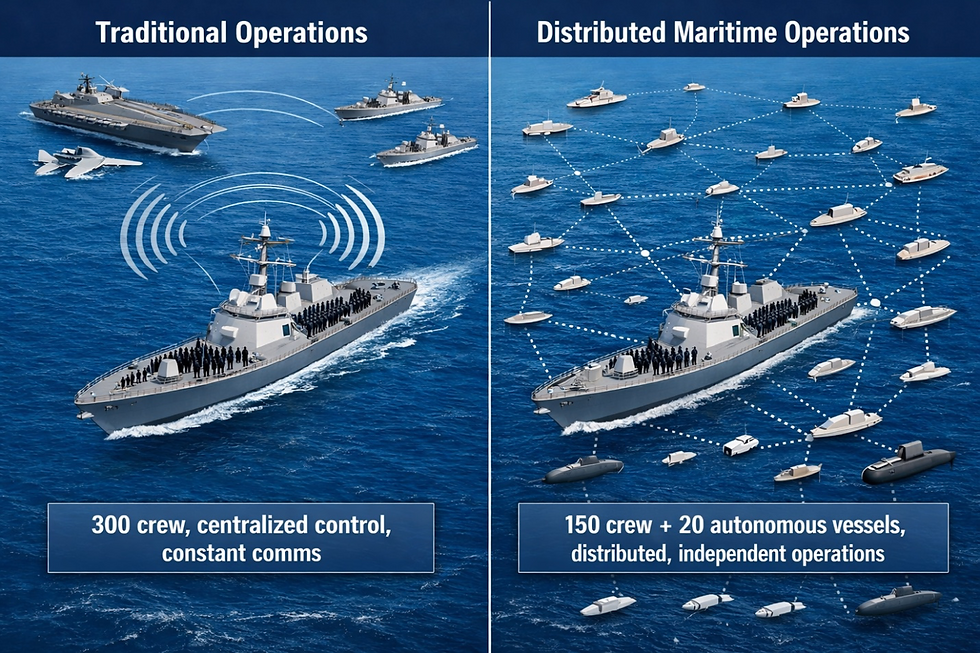
The pattern points toward fewer people, more capability per person, much faster decision cycles. But developing multi-capable humans creates a specific challenge for the Navy.
The surface Navy is being asked to develop operators who function like submarine crews, comfortable with extended independent operations, autonomous decision-making, and managing complex systems without constant supervision, but the surface community has traditionally selected and promoted for different traits. Submarine culture assumes independent operations and trains for it from day one. Surface warfare culture developed around coordinated operations within the strike group, with constant communications and centralized control.
This matters because multi-capable doesn't just mean more widely skilled. It means trusted with more authority, comfortable with ambiguity, and willing to act without waiting for direction. Those traits take years to develop and require different selection, training, and career incentives than what currently exists.
Here's the specific challenge: the multi-capable operator the Navy needs is exactly the person with the most civilian opportunities. An E-5 (mid-grade enlisted) or O-3 (junior officer) who can supervise autonomous systems, defend against cyberattacks, and coordinate multi-domain targeting is the same person who can command a six-figure salary managing autonomous logistics for Amazon or coordinating swarm operations for a defense contractor. If the Navy compresses 300 crew responsibilities into 150 crew without commensurately changing compensation, career progression, or operational tempo, the service will train highly capable people who then leave for better offers. The submarine force retains talent partly through submarine pay and a unique career path. Surface warfare has neither, and DMO makes the retention math worse. The decisive constraint in oceans and orbits may not be platforms. It may be humans trusted to act at scale without waiting for permission.
Simulation-based training can accelerate technical skill development [9]. But if we don't also change how we select, develop, and promote people, we'll have multi-capable operators who still wait for permission when the situation demands initiative.
The services that solve this first, building both the technical skills and the culture that allows people to use them, will have the human capacity the Indo-Pacific demands.
Scale forces autonomy. Autonomy forces delegation. Delegation forces institutional change.
The logistics architecture of a dispersed Indo-Pacific fight
Dispersion solves one problem and creates another. Spreading forces across wide distances improves survivability by making them harder to target. But every new pocket of survivable capability is also a new pocket that must be supplied, repaired, coordinated, and sustained under attack. The logistics complexity scales with the dispersion. The logistics architecture must match the operational concept.
The deeper problem is digital. Enterprise logistics systems performing capably today were built for network conditions that a high-end conflict with China will not provide. The scale of the Indo-Pacific theater and the depth of China’s ability to contest communications, degrade bandwidth, and deny connectivity create conditions that are categorically different from anything these systems have operated in. In a theater where forward nodes may be operating in near-isolation for extended periods, those design assumptions become liabilities. Intermittent connectivity, constrained bandwidth, and high latency are not edge cases to be handled later. They are the design target. Engineers must build to these constraints from the start, and simulation environments must be used early to surface the failure points that vendors are then required to fix before a program advances.
These are not hypothetical failure modes. The conditions that expose them are ones I have worked in directly. I have seen capabilities ruled out as operationally viable purely for this reason, and vendors unable to adapt because the constraints were too deeply embedded in the architecture to fix. Bandwidth and latency constraints are not operational inconveniences to be managed after fielding. They are architectural requirements that must shape system design while the systems are still being built. By the time a program has been fielded and integrated, the structural changes required to make it genuinely resilient are too deep, too expensive, and too disruptive to the surrounding architecture to be practical.
The question every program leader and vendor partner should be asking now is simple: what does this system do when it loses 90% of its connectivity for 24 hours? If the answer is that it degrades badly, that is an architectural problem, not a training problem. The fix belongs in the design phase, not after fielding. Systems built for distributed warfighting need low-bandwidth operating modes, tolerance for delayed synchronization, and workflows that remain usable when centralized coordination is unavailable. These are designable properties. They require deliberate choices early in development.
The distinction that matters most is between modernization for efficiency and modernization for survivability. Most digital modernization optimizes for the former: better visibility, faster coordination, tighter integration, more prediction. Those are real gains. But a system optimized for efficiency in connected conditions can become brittle in exactly the wartime conditions it is meant to support. The Indo-Pacific demands both. The window to get the architecture right is now, while modernization is still in motion and before the design choices harden into constraints that are too costly to reverse.
The budget shift is already here
The Indo-Pacific is the pacing theater, and modernization funding has followed. The shift has been building for over a decade and is now visible in every budget line. Fighting at ocean and space scale requires platforms built for range, persistence, and survivability at distance. Those platforms (ships, submarines, aircraft, and satellites) carry higher development and procurement costs than ground forces (soldiers, vehicles, and land-based weapons systems), which means a geographic shift toward maritime and aerospace domains translates directly into budget share moving toward the services that own them.
The Budget Control Act of 2011 was the structural turning point. Before it, the Army held roughly 24–25% of the Department budget, a share it had maintained steadily since the end of the Cold War. The BCA (Budget Control Act) forced a choice between mass and systems: because personnel costs are difficult to cut quickly, the Department reduced variable spending in training, maintenance, and R&D disproportionately in land-centric programs. The Army's relative share began a long decline it hasn't reversed.
By FY 2026, the divergence is significant. The total Department request reached $961.6 billion, with the Army receiving $197 billion (roughly 20% of the total), the Navy $292 billion (30%), and the Air Force including the Space Force $301 billion (31%). The remaining roughly 18% flows to defense-wide agencies. The combined Navy and Air Force share, the two services that fight at sea, in the air, and in orbit, now accounts for more than 60% of the Department total.
More telling than the topline numbers are the investment vectors inside them. In RDT&E (Research, Development, Test and Evaluation), the budget's clearest signal of where the future is being built, the Army requested $15.4 billion for FY 2026. The Navy requested $29.2 billion, roughly twice that. The combined Air Force and Space Force request was $51.6 billion, more than 3 times the Army's share. The ratio reflects the theater.
Space Force will see the largest percentage increase of any service by a wide margin. Between the base budget request and reconciliation funding, the Space Force is on track to receive roughly $40 billion in FY 2026, nearly twice what it received 5 years ago [10]. The driver is Golden Dome, the administration's missile defense initiative, which carries an initial investment of $25 billion toward a projected total cost of $175 billion [11]. But the underlying logic is broader than missile defense: everything in oceans and orbits depends on space for communications, precision timing, navigation, targeting, and resilient sensing. Space Force is building much of its architecture from scratch, which means the investment runway is long.
Navy shipbuilding is surging as well. Congress authorized $29 billion for shipbuilding in FY 2026, including accelerated funding for Virginia-class and Columbia-class submarines, Arleigh Burke destroyers, and the submarine industrial base. Congress also added $897 million for the Navy's sixth-generation carrier-based strike fighter intended to eventually replace the F/A-18 Super Hornet, reversing the Pentagon's decision to freeze the program in favor of the Air Force's F-47 [12].
The capability buckets attracting the most investment gravity are autonomous undersea and surface systems, resilient space architectures, long-range strike and hypersonics, distributed maritime logistics, AI-enabled command and control, and counter-UAS (Unmanned Aerial Systems) at scale. These are funded priorities. They will grow.
The Army's budget share will continue to decline in relative terms, but that trajectory is worth examining carefully. Service budget allocations inside the Pentagon tend to be politically sticky. Institutional inertia, congressional relationships, personnel structures, and infrastructure all resist rapid reallocation between services. The Army's share moved only gradually even after a decade of strategic pressure and a severe fiscal shock in 2011. The more consequential shift is in what the Army is asked to do with its share.
That shift is already visible. The Indo-Pacific theater is rewriting the Army's job description. HIMARS launchers (High Mobility Artillery Rocket System), designed for land-based rocket artillery, now move by landing craft to island chokepoints in the Philippines and Japan, where they rehearse firing on Chinese naval forces in the Luzon Strait. The Army is accelerating its Precision Strike Missile to give ground forces a 1,000-kilometer anti-ship capability. Army watercraft ferry Marine anti-ship missile launchers between islands. The Multi-Domain Task Force has deployed a ground-based vertical launch system, originally a naval platform, on land in the Philippines to fire Tomahawk cruise missiles and SM-6s (a Navy surface-to-air and anti-ship missile) against maritime targets. The pattern is consistent: Army systems and Army logistics are shifting to sea denial and maritime strike. The budget share stays. The mission changes.
The same logic applies to special operations forces, and it matters for the companies that supply them. SOCOM doubled in size and saw its budget grow sevenfold after 9/11, almost entirely in support of counterterrorism missions in desert and urban environments. That era is ending. The command has been directed to cut roughly 5,000 troops over 5 years, with reductions concentrated in the programs and force structure built for counterinsurgency [13]. SOCOM leadership has stated the direction plainly at the Special Operations Forces Industry Conference: "Capabilities to prevail in the Indo-Pacific are our priorities. Every investment we make will support this strategy" [14]. What is growing is undersea mobility, maritime strike from small surface platforms, and unconventional warfare capacity on Taiwan's front-line islands [15]. SOCOM is actively shedding the counterterrorism era and investing in the maritime one.
For the Defense Industrial Base, this distinction matters. The question isn't only whether a company's capabilities align with naval and air domains, but whether they can help land-based platforms extend into those domains. Ground-based long-range fires, distributed logistics across island chains, and cross-service interoperability are growth areas even inside a service whose topline share may stay roughly flat. Industry will follow this gravity. So will startups and non-traditional entrants. The question for any company in the defense space is whether their capabilities align with the domains that will actually fight at scale across oceans and orbits.
Golden Dome, Golden Fleet, and the Shipbuilding Imperative
Golden Dome and Golden Fleet are direct responses to the strategic reality this article has been describing.
Golden Dome is the administration’s missile defense initiative, carrying an initial $25 billion investment toward a projected $175 billion system [11]. It exists because an adversary doesn't need to sink your ships if it can destroy your satellites, blind your sensors, and disrupt your command and control first. Golden Dome is the recognition that the space layer is itself a warfighting domain that must be defended, not merely used.
Golden Fleet is the recognition that the Navy is too small for the theater it's being asked to dominate. As of late 2025, the U.S. Navy operated approximately 290 battle force ships [16], while China's navy has surpassed 370 and is projected to reach 435 by 2030 [17]. The U.S. fleet is on track to shrink before it grows. A declassified Office of Naval Intelligence assessment put China's shipbuilding capacity at 232 times that of the United States [18]. CSIS (Center for Strategic and International Studies) found that China's largest state-owned shipbuilder produced more aggregate tonnage (commercial and naval combined) in 2024 alone than the entire U.S. shipbuilding industry has since World War II [19].
This is why SECNAV John Phelan keeps returning to shipbuilding in nearly every public appearance. The Golden Fleet’s answer is a barbell strategy: heavily armed capital ships carrying hypersonics and command and control at one end, paired with large numbers of lower-cost unmanned surface and undersea vessels at the other [20]. More hulls, more weapons, delivered faster. The industrial challenge is real and the timeline is urgent. The Navy needs to grow significantly, and the base that builds it needs to operate at a pace it hasn't attempted since the Reagan era.
What this means for the Defense Industrial Base
These shifts are visible across senior operational and acquisition leadership. The question is whether the industrial base is adapting at the same pace. That creates 2 major calls to action for the Defense Industrial Base (DIB). Some leading companies are already repositioning. The gap is between them and the rest of the industrial base.
First, help solve Adapted Doctrine. New technology requires new ways of fighting. Work that helps commanders delegate differently, combine effects across domains, adapt command and control, and update doctrine will matter as much as new platforms.
Second, help solve Multi-Capable Humans. We'll need training ecosystems that produce multi-capable humans, not just specialists. Simulation, AI-enabled instruction, continuous recertification, and mission-realistic rehearsal environments will be essential.
A third call to action is structural. The contracting models that govern most defense procurement were designed for long-cycle, low-uncertainty programs where requirements were stable and time was not a constraint. That model produced the DIB we have. The Indo-Pacific demands something different: faster iteration, outcome-oriented delivery, and the ability to move at the pace of operational need rather than the POM (Program Objective Memorandum) cycle, the Pentagon's multi-year budget planning process. The Department has created pathways specifically designed to move faster. OTAs and middle-tier acquisition authorities (Rapid Prototyping and Rapid Fielding) bypass the normal requirements process and oversight that make traditional contracting slow. The tools exist. Adoption across the industrial base remains uneven. DIB leaders who close that gap first will have a structural advantage as the Department's urgency increases.
Fourth, help solve the digital logistics architecture. Distributed operations across the Indo-Pacific will only be viable if the logistics systems that support them were designed for the network conditions that a high-end conflict with China will create, not the conditions of wars we've fought before. That means vendors and program teams building logistics systems must treat intermittent connectivity, constrained bandwidth, and high latency as core architectural requirements, not late-stage hardening tasks. The platforms, the doctrine, and the people will all fail if the logistics layer becomes brittle under the conditions it was built to support. This is an open problem, it is solvable, and the window to get the architecture right is closing as modernization programs mature.
Oceans and orbits are the decisive terrain. Naval, air, and space power have moved to the center. Connected Systems is moving fast. The long poles are Adapted Doctrine, Multi-Capable Humans, and a logistics architecture built for the network conditions that a conflict with China will create. The question for every company in the defense space isn't whether this shift is real. It's whether their portfolio is aligned with the theater that will define the next generation of U.S. military capability. The strategic gravity has moved. Industry needs to move with it.
References
[1] Myers, L. "Internal Politics, Instability, and China's Frustrated Efforts to Escape the 'Malacca Dilemma'." Wilson Center, 2021.
[2] Kaplan, R. "The South China Sea Is the Future of Conflict." Foreign Policy, 2011. (Cites Hu Jintao 2003 remarks.)
[3] Posen, B. "Command of the Commons: The Military Foundation of U.S. Hegemony." International Security, 2003; Tangredi, S. Anti-Access Warfare. Naval Institute Press, 2013.
[4] International Energy Agency. Global Critical Minerals Outlook 2025. IEA, Paris, 2025.
[5] Brose, C. The Kill Chain: Defending America in the Future of High-Tech Warfare. Hachette Book Group, 2020.
[6] Carter, N. "A New Way of Warfare Requires More Than New Tech." War on the Rocks, January 2026.
[7] Congressional Research Service. Defense Primer: Agile Combat Employment (ACE) Concept. IF12694, 2024; U.S. Air Force. Air Force Doctrine Note 1-21: Agile Combat Employment. August 2022.
[8] United States Space Force. The Guardian Ideal. 2021; United States Space Force. Space Doctrine Publication 6-0: Mission Command. November 2024.
[9] Breeden, J. "Now you can train for the next drone war on simulated Ukrainian front lines." Nextgov/FCW, December 2025.
[10] Aerospace Corporation Center for Space Policy and Strategy. FY26 Budget Brief. August 2025.
[11] MeriTalk. "Pentagon Unveils $1.01T FY2026 Budget with Cyber, Space, AI Focus." June 2025.
[12] Senate Committee on Appropriations. Senate Committee Approves FY 2026 Defense Appropriations Bill. 2025.
[13] Baldor, L.C. "US special ops teams must cut 5,000 troops over next 5 years, push to recruit technical experts." Associated Press / Fox News, May 2024.
[14] Tadjdeh, Y. "Special Ops Tech Pivots to Indo-Pacific Challenges." National Defense Magazine, May 2022.
[15] South, T. "Submarine delays push SEALs to find new underwater approaches." Defense News, May 2024.
[16] USNI News Fleet and Marine Tracker. December 2025.
[17] Congressional Research Service. Navy Force Structure and Shipbuilding Plans. January 2026.
[18] Office of Naval Intelligence declassified shipbuilding capacity assessment, reported in The War Zone. July 2023.
[19] Funaiole, M., Hart, B., Powers-Riggs, A. "Ship Wars." Center for Strategic and International Studies, March 2025.
[20] SECNAV John Phelan remarks at West 2026 conference, San Diego. February 2026.